Bond OR Break - The Card Game
Bond OR Break is a fun and fast-paced card game for those interested in Artificial Intelligence (AI) and technology.
Players aim to “snap” and claim the pile of cards when two matching cards are placed down on top of each other. The deck is split into Beginners and Advanced. Players can use both decks, or just the Beginner deck, shuffling and dealing cards evenly among players. On each turn, players go clockwise in order, each placing a card face-up in the centre. If two consecutive cards match (see three ways to match below), players race to be the first to shout “Bond!” and claim the pile. If the player claiming the pile is incorrect, another can yell “Break!” and take the pile for themselves. The game continues until one player collects all the cards or the agreed-upon number of rounds is completed.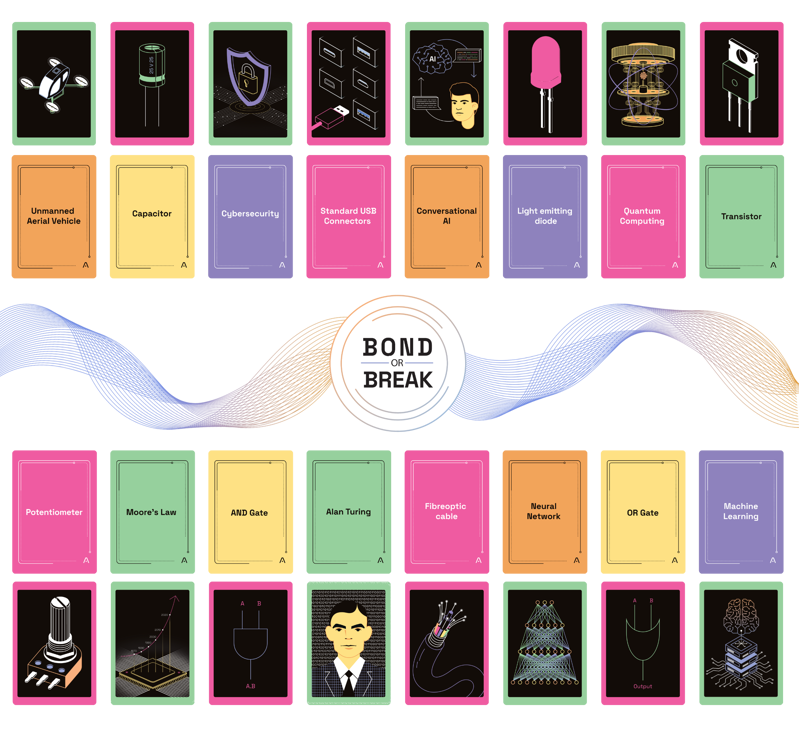
Card Descriptions
Pack 1: Core Concepts
Unmanned Aerial Vehicle (UAV): A drone or aircraft without a human pilot on board, controlled remotely or autonomously.
Moore’s Law: An observation that the number of transistors on a microchip doubles approximately every two years, increasing computing power. (though in practice, the “every 2 years” has slowed recently).
Neural Network: A series of algorithms that attempt to recognize underlying relationships in data through a process similar to the human brain.
Machine Learning: A subset of AI that allows systems to learn and improve from experience without being explicitly programmed.
Conversational AI: AI systems designed to communicate with humans in natural language, including chatbots and virtual assistants.
Quantum Computing: A field of computing focused on developing computer technology based on quantum theory principles, using quantum bits (qubits).
Cybersecurity: Protecting systems, networks, and programs from digital attacks aimed at accessing, changing, or destroying sensitive information.
Pack 2: Electronics & Logic Gates
Potentiometer: A variable resistor with three terminals used to adjust voltage or control current in a circuit.
Capacitor: An electronic component that stores and releases electrical energy in a circuit.
Standard USB Connector: A common interface for connecting peripheral devices to a computer using a standardized plug.
Fibreoptic Cable: A cable made of glass or plastic fibres that transmits data as light signals, allowing high-speed data transfer over long distances.
Light Emitting Diode (LED): A semiconductor light source that emits light when current flows through it, used in displays and lighting.
Transistor: A semiconductor device used to amplify or switch electronic signals and electrical power.
OR Gate: A digital logic gate that outputs true (1) when at least one of its inputs is true (1).
AND Gate: A digital logic gate that outputs true (1) only when all of its inputs are true (1).