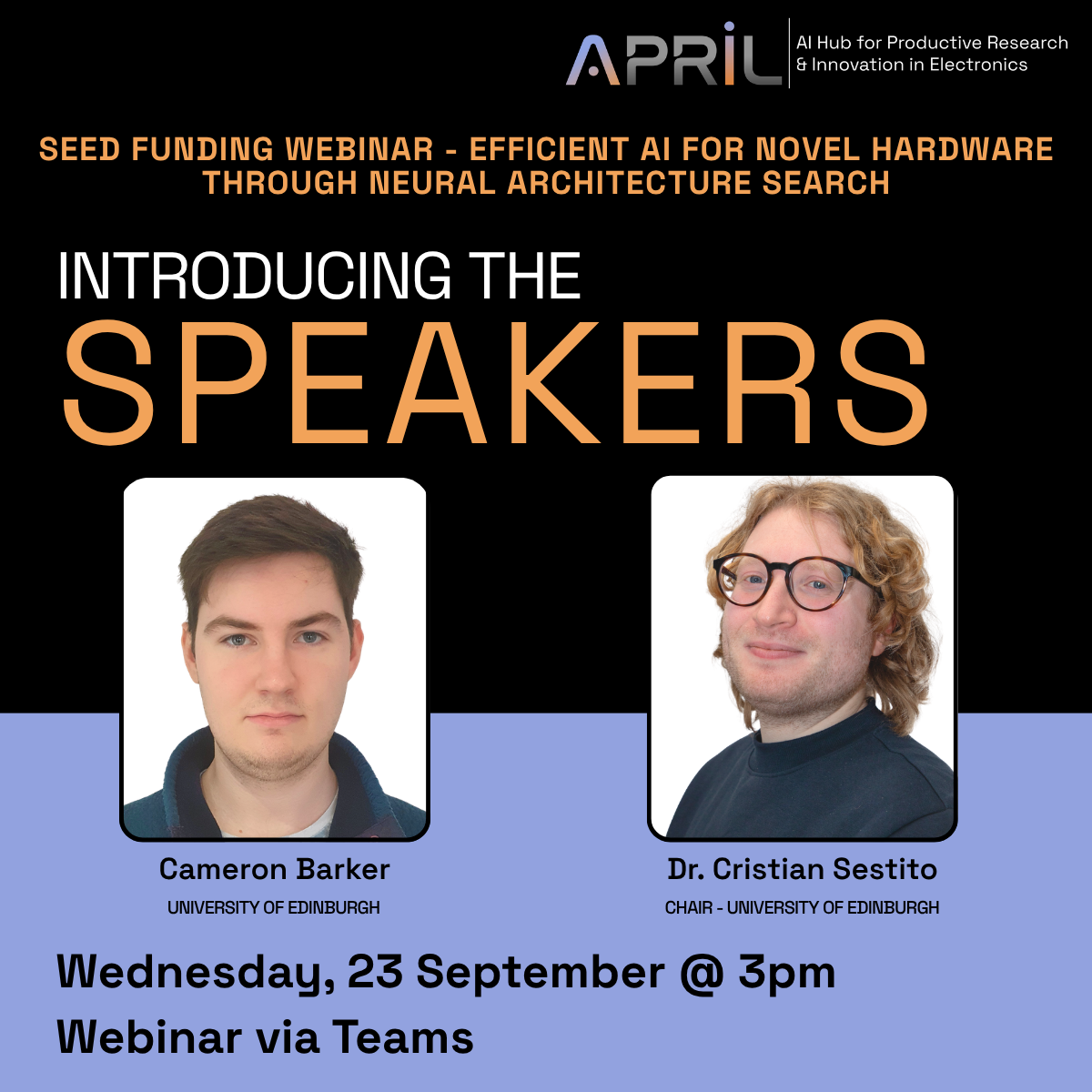
Seed Funding Webinar - Efficient AI for Novel Hardware through Neural Architecture Search
15:00 - 15:30 Online (Teams)
Talk abstract:
Deploying modern Large Language Models (LLMs) on everyday edge devices is severely bottlenecked by their massive memory and latency footprints, making post-training compression methods such as pruning essential. However, existing pruning techniques focus on simply cutting the raw number of parameters under a one-size-fits-all sparsity pattern, overlooking how physical hardware actually processes and stores different sparse layouts. This disconnect often produces pruned models that look small on paper but run slowly or inefficiently on real devices. In this talk, we present a hardware-aware pruning approach that eliminates this guesswork by automatically tuning both the sparsity structure and density on a per-layer basis to match concrete hardware budgets. By letting each layer choose its optimal layout, our framework bridges the gap between theoretical compression and real-world edge speedups, delivering models that preserve language capability while respecting the characteristics of the specific deployment device.
Bio:
Cameron Barker is a PhD researcher in Machine Learning Systems at the University of Edinburgh’s Bayesian and Neural Systems group. Advised by Dr. Henry Gouk and Dr. Elliot J. Crowley, his research centers on hardware-efficient machine learning, focusing on model compression techniques such as sparsity, quantization, parameter sharing, and hardware–software co-design to enable practical deployment on constrained edge devices.